Showing posts with label Travel. Show all posts

Friday, 16 October 2015

I've moved...

I've moved!  You can still find great posts about travel and everything else you have come to expect from The Rough Guide to a Lonely Planet at ---> http://roughguidetoalonelyplanet.com/

Please remember to LIKE and Share The Rough Guide to a Lonely Planet's Facebook Page too ---> www.facebook.com/TRGTALP

A huge thank you to everyone who has enjoy posts here.  I hope you will please join me in my new home!

Looking forward to seeing you there!

Thursday, 30 April 2015

The Nepal Earthquake - 80 Life-Changing Hours in Kathmandu

In a departure from the normal posts you usually see at The Rough Guide to a Lonely Planet, what follows is an account from a previous guest poster, MikeC, of his time in the Nepali capital of Kathmandu during the recent devastating earthquake to hit the country.  A big thank you to MikeC for his willingness to share his story with the readers here.  I hope you find it as engaging, thought-provoking and life-affirming as I did.

If you are keen to see MikeC's previous work, follow the link below to hear about his amazing journey through the less-travelled parts of Northern India. 

'Northern India...Off the Beaten Track'

---------------------------------------------------

Background to the events...
At 11.56am on the 25th April 2015, Nepal was hit by a devastating 7.8 magnitude earthquake. The epicentre was close to the town of Gourka mid-way between the major tourist hub and trekking jump-off point of Pokhara and Kathmandu. I was in Kathmandu at the time, preparing to depart for a month’s climbing in the Himalayas. This is my description of events taken from diary entries from the quake up until I was able to get out of Nepal, some 80 hours or so later.


The day of the earthquake...
I had just returned from some last minute shopping to get some things I needed to go climbing; some snacks, and the odd piece of essential clothing. I returned to the hotel and my friend Neil and I agreed to have half an hour to sort things out, have an early lunch and then head over to one of the Stupas in Kathmandu. A few minutes later, everything changed. Sitting on my bed for a few minutes reading, I initially felt a small vibration and the power went out. Being a common occurrence in that part of the world, I momentarily gave it little thought. That quickly changed when the full force of the earthquake hit. When the shock started, I decided to get out of the room and out of the hotel. I ran down the corridor, down the stairs and into the reception of the hotel where I was able to hold onto a supporting wall under a lintel. I remember looking outside and seeing walls, buildings everything collapsing around me. The shaking went on for about a minute, although at the time, it felt much longer.


Aftermath...
Once the quake stopped, we got out of the building and went onto the street, fearing aftershocks. Once on the road, a realisation of the damage started to hit home. Power lines were down, walls and buildings had collapsed, power was out, there was no phone reception. We went to a small car park; away from power lines and tall buildings and waited. Among us were many locals and foreigners. Most of whom were scared, confused and wondering what had just happened and whether it would happen again. Many people had injuries, thankfully none too severe, but some help was provided. There were two aftershocks while we were in the car park, during the second of which we met Hana, a South Korean girl who was travelling on her own and was understandably terrified.


(source - MikeC)


Making a plan...
After spending an hour or so in the car park, we talked and decided upon a plan. Many people didn’t do this, and I believe this made our lives over the following days far easier than they could have been. Preparation in these situations is key and taking a few minutes to take stock and assess a situation can save your life. We decided that we needed supplies and to be safe. We returned to our hotel which was still standing, I gathered a survival bag consisting of water, food, clothing, water purification tablets and medical supplies. We then went to Hana’s hotel so she could do the same. On the way, we saw complete devastation, collapsed and subsided buildings, more power lines down, cracks in pavements, roads and buildings as well as lots of people shocked by what had just occurred.


(source - MikeC)


Shortly after our thoughts turned to friends in Kathmandu. Both for ensuring they were OK as well as getting some local advice on what to do and where to go. Fortunately having spent a long time in Kathmandu over the last 12 years, I know the city well. So, we decided to set out for my friend, Basant’s office (as we couldn’t get any signal on our phones). It was a half-hour walk past more destruction. We got to Basant’s office around 3pm, but there was no one around. We spoke to one local who said he knew him, but had not heard anything. So, we decided to keep moving and get away from buildings. We headed down to Ratna Park, open, safe and with lots of people. This would give us chance to take stock. On the way, we walked past the clock tower in Kathmandu, the clock frozen at 11.56am. A poignant reminder of what had happened only a few hours ago.


The Clock Tower - 'stuck' at 11.56am (source - MikeC)


Taking stock of things...
In the park, we were able to sit and take stock. We didn’t want to go and had nowhere to go to. Neil was able to barter an old pair of sunglasses for some tea; we had a couple of drinks and talked about what had happened and what we thought was going to happen. There were a few more aftershocks, but none too bad. We waited until sunset, but decided to head back before it got too dark. We knew there was a small, but open café close to our hotel and there might have been a working Internet connection. On the walk back we saw further destruction. Buildings collapsed, shell-shocked people sitting on the side of the road, people trying to gather what they could from the ruins of their houses and their lives and people looking for loved ones. The realisation of what had happened perhaps starting to sink in.


Telling the world I was alive...
We returned to the hotel and café and somehow was able to get online. Of course, Facebook was inundated with messages, posts, comments etc. We were all able to get a message out to people that somehow, by some inexplicable piece of luck, karma; call it what you will, we were all alive. We remained in the café until around 11am, taking advantage of social media and electricity while we had it. We also had a hot meal, not knowing when we would do so next. After much discussion and consideration, we decided to go back inside. In hindsight, this was one of the two mistakes I made during the four days – I’ll get to the other later. We did however pack our bags carefully with all equipment in/attached to it. To say we slept is an overstatement, we rested, but a number of small aftershocks as well as nerves kept me awake. Around 5am, a 5.6 aftershock hit us which sent us scrambling out of the building and me cursing myself for my stupidity and putting us in danger.


Day two...
We spent the next few hours in the café garden, still with Wi-Fi, but little else. We were able to update people about our condition and to formulate our next plan. We had heard a rumour about the British Embassy wanting to make contact with British Nationals and that they were formulating a plan. At the time we believed this was true; this was the second mistake I made – as time went on, we learnt how quickly misinformation and rumour can spread. We made it to the British Embassy, I spoke to the Commanding Officer – the embassy is quite militarised and it run by the Ghurkhas. The Officer told me him and three staff were looking after 158 British Nationals, they had little to offer, but said they could take myself and Neil in, but Hana, being South Korean would understandably not be allowed in. It was also suggested we go to the airport and the South Korean Embassy.

It was here that we saw the worst of people. It was the only time. Overall, I was blown away by the kindness and generosity of people – I’ll get onto that, but this was the one time I witnessed exploitation of the situation. The taxi journey to the South Korean embassy would usually be a few hundred rupees, maybe £3. When I finally found a taxi driver, who would go, they wanted 1500 rupees per person. After an exchange of expletives, he left and we abandoned that plan and went to the airport. Unfortunately, 10000 other foreigners had the same idea. The airport was chaos. No one knew what was happening, no staff had turned up as they were either injured, dead, or had gone to check on/look for their family. We quickly decided to abandon that plan and head back to Basant’s office. Thankfully when we arrived, he was alive and well. We discussed what had happened and were able to get a copy of an albeit small newspaper. It told us of the death toll, but we all knew it would rise.


Making a plan to get home...
We started to discuss onward flights and getting home. After calling home on Basant’s somehow working landline, I tried to call the airline, but at 12.50pm mid-call a 6.5 aftershock sent us running outside, by the time we were able to go back inside, the line was dead. We realised we needed somewhere to stay, which wasn’t inside. Next to the office was a small park run by a group of Hare Krishna’s who had a commune for people of all faiths and beliefs. They very kindly welcomed us to live with them. They couldn’t offer much, just a piece of grass and a tarpaulin for a roof, but it was a wonderful gesture, one which we will never forget.


After getting settled and speaking to some of the others in the park (we were the only foreigners), I decided we needed another plan. While the airport was no use, maybe the airline offices would be able to help. We found quickly however that they were all closed; staff having gone home and many without power. It didn’t take us long to abandon the re-booking plan and decided that buying any flight out was the best solution. This of course would only work with an Internet connection. By this time the power in the café had run out, so we went on a Wi-Fi hunt with dying batteries and no way to charge them. Hana knew of a Korean café which according to some people she had met still somehow had working Internet. We tracked it down and amazingly it worked! We were partly relieved, but knew we had many more obstacles. The first being the structural integrity of the building. It was standing, but a number close to it had collapsed and were dangerous, so we didn’t want to linger. Just before the battery died, I was able to get a flight booked with Qatar Airways for Tuesday evening which was a great relief. Hana was able to get one for herself for the following morning. We were overjoyed and left to go back to our new home in the park.


Helping others...
On the precarious walk back past unstable buildings and through dangerously narrow streets; we met a group of Czech people who had just got back from their trek, but having missed the force of the quake. Their hotel was unusable and they were in need of shelter and accommodation. We suggested they came with us and they were delighted at the offer of somewhere to stay. They were well equipped for camping and mostly self-sufficient which was great as none of us wanted to overly burden our hosts. We returned to the camp to be given a plate of rice with a few vegetables. A moving gesture given what the people had gone through. We felt touched that as complete strangers, the generosity of those who had nothing extended to giving us a warm meal.


(source - MikeC)


Exhausted people began to bed down for the night around 10pm, but none of us really slept, the pouring rain, the aftershocks, the nervous conversations of people and the general apprehensiveness made sleep elusive for a second night. Around 5am the following morning some people left to assess their homes. For most the news was bad and they would be forced to return.


Day three...
Later than morning, I went in search of food. We had mostly been living of energy bars and peanuts and I felt some fruit or vegetables would not only prove a welcome break but keep us healthier. I was beginning to worry about the outbreak of disease, there was no running water, the sewers had backed-up and rubbish was piling up. I was able to find some fruit from a market which was a great relief. It was more expensive than usual, but not overly so. I was impressed at the self-control of people for not panic-buying. I believe the good-nature of Nepali people and the concern for others maybe prevented hoarding. Such discipline and concern or others, I don’t believe would have existed in the West.


Assessing the damage...
We decided to go and assess the damage around Kathmandu, gather a few more missing possessions and get a better idea of what was happening in the rest of the city. We were able to find a couple of restaurants and cafes which were somehow functioning. Somewhere to get a cup of coffee and a meal was a great relief. Not only for our own well-being but also because we didn’t want our hosts to feel obliged to waste food on us.


We returned for our last night to the park and spent time talking to the locals. Much of this was dedicated to dispelling rumours. Rumour, we learnt was one of the biggest problems here. A lack in knowledge about earthquakes meant people believed all sorts of stories most of which lacked any scientific evidence. Many times we heard people saying ‘there will be another earthquake at 3:30pm. This was of course complete rubbish, but created panic and hysteria. A few basic lessons in plate tectonics gave some of the locals a little more comfort in understanding what was happening and why it was happening. This was the first evening when we heard planes and helicopters flying overhead. Mostly aid planes and helicopters flying to the mountains to rescue people stuck. It was a reassuring sound to hear, but didn’t make sleep any easier.


Day four – time to leave...
The following morning was sunny and warm. I decided to take a short stroll around to assess what was going on. Not much had changed, but a few people had begun to go home. I saw a few Red Cross tents, but little else. The Government had begun to deliver water in large tankers and people were (again without panic) filling up containers. This was the morning of our flight and knowing the chaos of the airport, two days previously, I wanted to give ourselves a lot of time. After meeting Basant, changing clothes and getting ready, he asked if I could take one of his volunteers, Giulia, to the airport as well and help her. Around 9:30am, we set off for the airport expecting the worst and in no way assuming we would be leaving. Check in for Qatar Airways was easy, Etihad for Giulia was anything but. The previous day’s flight had been diverted to Delhi as there had been too many planes on the tarmac for it to be able to land. While of course the aid was needed, the clogging up of the airport probably caused as much harm as good. Much of the blame of this has to fall on the Indians for acting without thinking. Eventually we were all checked in, through security and ready for departure. We all had a few hours nervous delay as more rumours spread about cancellations, but in the end we were all aboard our respective flights and heading home to great relief, exhaustion, but also a fair amount of survivor guilt.


Emotional effects of leaving...
Things for me really hit home when I landed in Doha, firstly seeing lights on, having electricity and Internet was all very unusual. I walked past a restaurant in the airport around 1am and it was full of people eating, drinking, relaxing and doing normal things, a few snoozing on their chairs. I thought back to the last 4 days, could there be a greater juxtaposition in any given period of time?

The day I returned home I went to the supermarket to get some things which I had had to leave behind. I ended up walking past the vegetables and found myself looking at the mushrooms. For no particular reason I don’t think, but I remember looking and thinking, what has happened to our world where people demand to have a choice between eight different types of mushrooms while most of the people I had been living with the last few days probably won’t eat tonight. Many of the injustices in the world came crashing home at that point. While I don’t think of myself as an overly materialistic person, this experience has taught me so much about the world and what we deem important. It has also taught me the kindness and compassion which most people have. It also reminded me of the importance of being prepared. I’m not talking about constantly remaining on edge expecting something to happen, just that when it does; taking a few minutes to take stock and consider your options so you can make informed decisions can be the difference between life and death.


MikeC - Safe and Well (source - MikeC)


Personal thoughts and advice...
For whatever reason, my hotel didn’t collapse while others did. That is just the way things happened, there is nothing you can do about that, but you can be prepared to make decisions. We were, others were not. Everyone suffered, we, I believe suffered less as we were prepared and didn’t panic. I hope that no one has to go through what we and the people of Nepal have recently gone through, but if you do, take stock, come up with a clear plan of action, don’t make rash decisions, take rumour with a big pinch of salt and be prepared. Water, clothes, high energy food, water purification tablets, medical kit and a solar charger for your phone are all vital things and can keep you alive. A pen and paper with phone numbers and addresses of travel companies, embassies, the emergency services are all indispensable. For me, being able to write my experiences also made a big difference in enabling me to re-tell this story so that I can share my experiences and hopefully help to prepare you for what might happen if you are unfortunate enough to experience anything similar.

---------------------------------------------------


The relief effort to help the people of Nepal is a huge task.  The priority is to help those in need now; those caught up in the immediate aftermath of the earthquake.  Based on who he saw 'on the ground' in Nepal, MikeC has suggested the following charities, should you want to donate to help those affected by this catastrophic event.

Medecins Sans Frontieres - http://www.msf.org.uk/country-region/nepal-earthquake-emergency-response

The International Red Cross - https://www.icrc.org/en/document/nepal-earthquake


Water Aid - https://www.wateraid.org/uk/donate/nepal-earthquake-relief?id=NP9999%2c15/QBB%2cCshOth%2c15/QBB/00A


Sunday, 15 February 2015

An Ethiopian Trek (A Guest Post by Calum)

He's back!  After writing about Berlin in November 2013, Calum has returned!  Only this time, we find him in Africa, exploring the magical beauty of Ethiopia; a destination that is growing in popularity as more and more travellers take advantage of the good connections to the country and begin to realise what this fascinating country has to offer!

------------------------------------------------------------

Read any piece written by travellers to Ethiopia in the past 10 years and your preconceptions will be blown away. The country is still poor but news pictures from starving refugee camps are long in the past. Instead think lush green countryside, awe inspiring landscapes and a country rich in cultural and religious sites. From rock-hewn churches of Lalibela, to the claimed home of the Ark of the Covenant in Axum, the North offers much for the 21st century traveller, though infrastructure remains in the early stages and getting around can be hard.

My friend James and I spent two weeks backpacking around Ethiopia’s Northern circuit taking in Addis Ababa, Gonder, Axum, Lalibela and the Simien Mountains National Park. It provided just the inspiration I’d been looking for to offer up another piece of writing to The Rough Guide to a Lonely Planet. Below is a short snapshot from three days in the middle of our trip.

...Our pick-up arrived outside the L-Shape hotel in Gonder at 7 a.m. Despite the slightly charred omelette served for breakfast, and the two hour power cut the day before, the L-Shape had offered a relatively pleasant stay. A stylish looking chap with dreadlocks jumped out the van and enthusiastically introduced himself — “I’m Yur Kuk, and I’ll be trekking with you over the next few days”. An unusual name, I thought. James and I jumped in and the van pulled off. It went round a few streets before pulling over to the side where Yegsaw jumped in behind us.

The road into Gonder on the day before setting off on our trip (Source - Calum)

Yegsaw had organised our three day trip to the Simien Mountains the previous day but now he looked a tad nervous. “The rest of the group have cancelled”, he said. “I’m going to have to ask for some more money, another $25 perhaps”. The atmosphere went cold. Yegsaw had offered us a good deal on the basis of having another group of trekkers we could join. He began mumbling about how one of the group was ill and they’d had to delay their trip.

“You’re asking us for another $25?”, I said, after a few minutes awkwardness in the van.

“The cost is higher because the others in the group have cancelled.”

I wasn’t enjoying the news. “If the others have cancelled that’s not our problem. We agreed a price and you were happy to take money from us last night. You took on that risk.”

“Well the cost is higher and I need to ask you to pay more.”

“Well, how about we stop the van, cancel the trip and we get out here. You can refund our money and we’ll find someone else to arrange our trek.” I looked at James and he didn’t look pleased either. Neither of us wanted to cancel the trip — we only had two weeks in Ethiopia and it was a struggle to squeeze in a three day trek as things were. We were both not very chuffed with our agent Yegsaw at this point.

“I don’t think you should cancel, but I do think you should maybe consider paying a little more”. Yegsaw seemed slightly less sure of himself now. I told him we wouldn’t be paying any more. At that point he said goodbye and exited the van, leaving us with the driver and Yur Kuk.

We’d had a frosty start to the trip but we were to have some fantastic adventures over the next three days. The scenery was breathtaking throughout; we had lunch by the river whilst families of Gelada baboons crossed in front of us, saw Jinbar waterfall with a 500 metre drop and witnessed the most spectacular views from Imet Gogo at 3926m. Our guide and scout, Mesi and Moulali, looked after us well. It transpired that ‘Yur Kuk’ had actually introduced himself to us as the camp cook. Much to my embarrassment I’d invented him a new Ethiopian name. He was a mysterious character whose real name we weren’t to find out, but he made the most fantastic pancakes and coffee for breakfast and prepared supreme meals each evening when we reached camp.


Gelada baboons walk along the escarpment in Simien Mountains National Park (Source - Calum)

There was one thing we’d been nervous about the whole trek. Yegsaw had promised to arrange us travel to Axum, our next main destination. We were to stay one night in Debark following the trek before travelling on. After our exchange with Yegsaw in the van we were much less confident that the travel arrangements would come through.

After three days trekking we were picked up and driven out of the park, onward to our hotel in Debark. It was a miracle to have a shower after three days away, but now we had business to attend to — we had to decide what to do about our planned, or possibly not planned, journey the next day.

I began asking around the hotel for information. If Yegsaw hadn’t arranged our transport the next day how would we get to Axum? As always in Ethiopia, things would be slightly complicated.

A bus left Gonder at five-thirty each morning for Shire, passing through Debark sometime between 7 and 9 a.m. This would take us most of the way and from Shire we’d arrange a minibus ride the final two hours to Axum. However, as the bus usually set off full from Gonder we’d be unlikely to get a seat in Debark. To secure a seat we’d have to have someone travel the Gonder-Debark part of the route on our behalf. Our hotelier could call back and arrange for someone to get on the bus there, but on top of the bus ticket this would involve a fee. The arrangement sounded slightly odd but it did correspond with information given in the Lonely Planet guide. I decided this would be a good time to call Yegsaw for a chat.

Yegsaw’s English was good enough for him to have sold us a three day mountain trek but otherwise fairly basic. Unfortunately my Amharic is completely non-existent. I did manage to ask Yegsaw how he was going to deliver our tickets. I expected him to ask us for more cash. Instead he said: “Be at the bus station tomorrow morning at seven, they’ll be there”. There didn’t seem much else we could do.

On the main road through Debark (Source - Calum)

Other than being a place to await onward transport Debark offers little for the traveller. We sat down in the hotel restaurant and ordered ‘Pasta and Meat’ — possibly the least risky looking option on the menu — before heading back to our room. Tomorrow we’d find out whether our bus journey would come through.

Less than ideal surroundings in Debark (Source - Calum)

7 a.m. at Debark bus station is miserable, utterly miserable. James and I arrived with our packs. The hawkers seemed to leave us alone once we confidently told them we already had people looking after us. If only they knew. Debark was a basic town and if the dusty high street full of corrugated iron shacks had little to offer then the bus station had even less. Agents shouted ‘Gonder-Gonder-Gonder-Gonder’ as minivans came and went. Carrion picked on the animal vertebrae on the ground to my left. I didn’t feel hungry at all.

Two hours later the bus finally pulled in, did a turn-around and stopped. The engine kept running — I imagined the driver wouldn’t dare turn it off given how much trouble it might take to restart — and a young boy jumped out the side door to pop a brick chock behind the front wheel. Passengers began getting off to stretch their legs and behold, our man with the tickets was there!

Always tip the man who loads your luggage. You really want it to be strapped on tight! (Source - Calum)

The bus waited in Debark for thirty minutes before setting off. It turned out this would be the only stop. I had no idea how long the trip to Shire would take but I’d read minivans for Axum stopped leaving at five in the afternoon. Driving in the dark is dangerous in Ethiopia and the risk of hitting livestock is high. In addition, many vehicles on the road don’t have or don’t use lights and head-on collisions are commonplace. There’s a much higher likelihood of encountering bandits too. We had no idea how long the journey would take but we were sure we should be there by 2pm. On the map the distance from Debark to Shire looked 100km as the crow flies. Surely it couldn’t be much more than that by road.

Three o’clock and still Shire was nowhere in sight. We’d approach villages, “this must be it, it must be”, I’d say, but no, the bus would carry on through. Checkpoints seemed to be becoming more frequent. Police officers would stop the bus, get on and check everyone’s identity cards. A few times they made us all get off and stand outside though I’ve no idea why. An hour later we began entering a much larger town than the rest. ‘This must be it, this really must be it.” Inda Aba Guna the sign said. There was still another 20km to go.

From left: James, Mesi, Moulali and myself (Source - Calum)

Taking the harder road often offers the richest rewards. It’s two months since I arrived back in the UK yet I’m still continually reminded of contrasts between Ethiopia and home. Taking a comfortable car journey up the M5, browsing the shelves in the local supermarket or even just being able to flick a light-switch with some confidence the lights will actually come on. Things will become easier as time goes on but I firmly believe the richest possible experience to be had in Ethiopia is now.

Sunday, 28 September 2014

Inspiration - That Photo (Part 3) - Mauritius

The Rough Guide to a Lonely Planet, at its heart, is essentially about inspiring you to travel.  In the past, I have posted photographs that I hope will have made you consider a destination you may not have thought about visiting before or opened your eyes to the incredible beauty the world can offer you when you travel.  Check out my two previous posts here and here.

To continue this theme of inspiration through photography, I wanted to post a number of images from a stunning country Indian Ocean country I visited this year.  Ladies and gentlemen, I present to you, the one, the only...Mauritius!

 The 'mushroom' rock off the Ile aux Benitiers

 The Black River Gorges National Park

 The Black River Gorges National Park

 The Coloured Earth at Chamarel

 Incredible view across to the Ile aux Benitiers

 A panorama over the Grand Riviera Nord

 Flat Island as viewed from Coin de Mire

 The lilypads at The Seewoosagur Ramgoolam Botanical Gardens

 Some beautiful island flora


 Sunsets from Pointes aux Piments

 Pereybere


Trou aux Biches 


Sunday, 15 June 2014

Budget Bliss!


Three Star Luxury in Mauritius! (source - MikeW)

Three stars!  That is all it takes to please me.  I write this blog post (in my Moleskine) as I lounge by the infinity pool in my three star hotel in Mauritius.  Up to this point, I have apologised four times already for a number of things I need not apologise for; namely the numerous attentive staff just doing their job.  As a regular user of hostels and other types of budget accommodation, this three star palace is the height of luxury for me.  To be fussed over with hot towels, served drinks at my sun lounger and to be treated with some degree of deference is something of a novelty.  And, to be honest with you, it is a little embarrassing!  I am eternally thankful to be blessed with with a cheap taste for travel; so to have an army of hotel staff tempting me with a host of foods and drinks, clearing away my litter and lifting heavy bags, all with a cheery smile, is completely unfamiliar to me.  I am no Diana Ross.  I have no diva-ish tendencies that might suggest I have delusions of grandeur when it comes to travel.  I am a dyed-in-the-wool Yorkshireman who firmly believes that you should not make others do what you would not do yourself.  So, to have a retinue of staff to do your bidding just seems a bit silly!  But, I forget.  This holiday is a momentous one; where I am celebrating, with my family, a number of special occasions.  I am not backpacking through Eastern Europe on a budget of £10 per day or trying to negotiate the lowest price for a room in Croatia.  I am in this Indian Ocean paradise to relax.  I have certainly paid a fair whack for this and should certainly let the staff here take the load.  This is a treat!  I have a fairly stressful job where I think constantly about the welfare of others; so to have someone make my bed and clean my room for me each day, as well as bring me drinks and cook me sumptuous meals is an unadulterated joy...and, one I should savour!  Sure...I am only here for 10 days, but how lovely it feels to let those stresses ebb from your body as you sink into that sun lounger, pick up your book, dip into the pool, back to your book, dip into the coral filled tropical ocean, read more of that book...

MikeW 'Slumming It'! (source - MikeW)

So, you may feel out of your depth; a little above your financial station, but my advice to the budget conscious traveller out there - give it a try!  Throw yourself into the lap of luxury for a week or two!  Besides, you save so much on your other trips, why not live it up for a while; even if it does mean 'slumming it' in a three star!

Safe travels!

Saturday, 10 May 2014

Hostel Virgin?

You're a virgin?!  You mean you have never experienced one before?!  A bit scared about it?  Well...let me help you; I've done it loads of times before!  With my advice, I guarantee you will have a pleasurable experience EVERY time!  Is this sexual nirvana, I'm referring to?  Nope...I'm talking about your first stay in a hostel.  These FIVE top tips will help you through your first hostel stay.

For the hostel averse out there, my advice is to give it a try.  As I have said before, hostels are an affordable, good value accommodation option for the budget-savvy traveller.  And for those that do not fancy the sights, sounds and smells of your average dorm room, staying in private rooms in hostels need not feel like you are 'slumming it' and can give you access to a host of activities and services you might miss out on if you were to stay in a hotel.

Par-tay! (source - hostelworld.com)

1. Choose Your Hostel Carefully...
- Selecting the hostel that most suits your personality and travel requirements is key.  Need a riotous party?  Make sure the hostel you choose offers free shots on arrival and bar crawls every night.  Need to chill out after a day's sightseeing?  Opt for the hostel that can hook you up with a local yoga class and 'knits' their own muesli for breakfast.  My main advice here would be to read the reviews on hostel booking websites such as Hostelbookers and Hostelworld; where travellers post frank reviews about their experiences and the quality of the accommodation on offer.

I just need to use my hair straighteners...and charge my iPad...and my camera battery! (source - open.edu)

2. Don't Be The Hostel Oddball...
- You are likely to be sharing a dorm room with several others.  It is therefore, paramount that you do not mark yourself out in a negative way in the microcosm of the hostel environment.  Taking up all the floor space, leaving your underwear strewn across the room or hogging all the plug points for your phone, iPad and hairdryer is not going to win you many fans.  The key to being a good 'roomie'?  Easy!  Treat others as you would expect to be treated.

Greet the travel massive! (source - mastersotu.com)

3. Press The Flesh!...
No, not that way!  Though, that will help you make friends very easily!  Hermits and hostels do not go together very well.  The recluse will find it difficult, in the sociable community you get in most hostels, to be completely alone.  This, for me, is one of the real advantages of a hostel stay.  You get to encounter and share experiences with fellow travellers.  These 'micro United Nations' allow you to meet people from different countries, cultures and socio-economic backgrounds that, ultimately, help you understand yourself, your own country and its unique culture a lot better.

Breaking bread at the Lisbon Lounge Hostel (source - MikeW)

4. Get Active!...
Linked into the previous tip about the social nature of backpacker accommodation; hostels will often offer a range of formal and informal activities I would heartily encourage you to get involved in.  For example, the fantastic Budapest Bubble hostel runs an informal nightly bar crawl which allows even the most hardened wallflower the chance to join a group of like-minded travellers for a drink or two without the pressure to finish the night at 5am, staring up from Hungary's finest gutters and covered in vomit.  However, that option is there...if you want it!  The brilliant Lisbon Lounge Hostel is one of many excellent, top quality boutique backpacker pads in the Portuguese capital that offers a number of free and reasonably priced activities for their guests from free tours of the city (something I highly recommend in any city you visit - see 'The Glorious Free Tour') to tours of the Fado scene as well as fabulous in house dinners, cooked by Pedro the chef, for a reasonable price that would shame many of Lisbon's well-established and costlier eateries.  Remember...a good hostel and its staff will want to show off their city and country at its best and ensure you have a great time.  At the very least, make it a priority, once you have dropped your backpack, to ask a member of the hostel staff to sit down with you and map out the best places to visit, eat and drink.  This quick orientation can be a good way to get to know your hosts and offers an invaluable local insight into your destination.

Lock it up! (source - onestop-padlocks.co.uk)

5. Stay Safe!...
I am the first to admit, I am anally retentive when it comes to my safety and well being when I travel.  In addition to this, I am keen to ensure my belongings remain safe and secure.  When I stay in hostels I always take a good quality medium sized padlock with me to lock your backpack or to allow you to lock it or any belongings in the lockers many hostels provide in the rooms.  And, if there is a safe in the hostel...use it for your passport, at the very least.  I have stayed in hostels where people have left valuable electronic items within easy reach and in once case an iPad on their bed while completely unattended in a busy room of 9 other strangers, while the woman went for a shower.  This was despite having a locker in which she could have easily stored the tablet safely and securely.  It made no sense to me.  I do not mean to worry you and you should not be consumed by fear about hostel security as most hostels are filled with friendly like-minded folk who probably will have absolutely no interest in your treasures, but the way I see it is...the less hassle you can get into the more enjoyable your trip will be; saving you from laborious insurance claims, visits to the police and angst about the cost of replacing your stolen belongings.

So, there it is...five great tips to help you navigate your first stay in a hostel and make it go as swimmingly as possible.  Please let me know, in the comments box below, how your first stay went or if you have stayed in hostels before the tips you would offer the plucky hostel first timer.

Monday, 5 May 2014

Why I Blog About Travel...

MikeW checking out Ljubljana! (source - MikeW)

After two years of blogging about travel, I have realised I am writing in an overcrowded part of the Internet.  Blogs about travel, independent travel, budget travel and backpacking are numerous.  Many of those writing have established their space on the web longer than The Rough Guide to a Lonely Planet and have reached further around the globe than I can possibly hope to do at this current moment in time.  So, why do I choose to write about travel when there are thousands of others doing very much the same?  The simple answer...I like it!  Travel and experiencing other places are a genuine passion of mine and I love to share this with others.  As I have written about before (The Art of Travel Blogging), I do not like to scribe trip reports for you as I find, on the whole, reading other peoples' similar blog posts dull and incredibly self-indulgent.  And, besides, so many people can write these types of posts better than I ever could.

Am I hoping for a press trip?  Are the 'Rough Guide', 'Lonely Planet' or a national newspaper going to beat down my door so they can fly me out to South Africa, tasked with a 2500 report on wine trips to the Stellenbosch?  Of course not!  I am utterly and completely realistic about the potential for this to happen.  It just isn't going to!  So many other bloggers out there have a larger following, a more regular readership and seemingly write more than I can on a more frequent basis.  Is the hope that I can make this a full time job?  If only!  A pipe dream at best.  Even those that write about travel full time report that pay is low and can often be disproportionate to the work and effort involved.

So, if I am not doing this for the 'free' trips or to earn a crust, my objective is clear.  I am here to inspire YOU!  To encourage you to travel.  To see the world.  To break free.  To explore.  To take that adventure.  To set sail.  Do it!  Then, one day you might decide to inspire others with your writing too!

Happy travels!

PS - If there are any rich benefactors or wealthy patrons out there with money to burn...you know where I live! ;)

Sunday, 23 February 2014

Aim High! aka TRGTALP's Guide to Great Views!

In my last post, I wrote about, and included some pictures, of my climb to the top of Zadar's highest building, the Bell Tower at the Cathedral of St Anastasia.  I gushed about how the ascent to the top of this fine bell tower afforded some fantastic views over the Old Town and across the sea to the islands that lie off Zadar.  Even before I started the climb, I knew it was going to be good; views from atop a building almost always are.  And, it is this that I urge you to do whenever you travel...AIM HIGH!

I always enjoy taking in the view from hillsides to dizzying my high Ferris wheels to glorious edifying monuments of a Communist past and even the odd ancient religious building.  It must be in my nature as a Capricorn; the desire to want to be like the mountain goat and climb to the top of all that is high.  If there's a tall building with a viewing platform, I probably will want to be up it!  The funny thing is...when faced with these ginormous buildings, my foot on the first step of a 354 step spiral staircase climb, I often think, "Surely the Benedictine Monks installed a lift!"  But, despite my moans, both internal and to anyone who will listen, I always think it is worth the effort and have never regretted a hearty ascent and the view that comes with it.

I'm not going to lie to you. These climbs are not for the faint-hearted!  You will need to be of good health, risk life and limb when placing your foot on that ropey looking wooden step and happy to be pressed up against a whole host of travellers; in many cases, on both the ascent and descent!  On the whole, you'll  find that it is more than worth the hassle and a great way to get up close with your fellow traveller...whether you like it or not!

So, where can you grab a feast for your eyes from on high?  Below, I have listed a tiny amount of the world's best dizzying highs; splitting them into free highs and ascents you are going to have to pay for...

TOP 3 FREE VIEWS...

- Primrose Hill, London - This North London spot offers great views over this mighty fine city. Grab a picnic, get among the crowds on a summer's day and live the high life in this fantastic city!


(source - wikipedia.org)

- Griffith Park, Los Angeles - The City of Angels has its detractors, but who could argue with the stunning view from Griffith Park, looking over this sprawling US metropolis?

(source - drewrtw.blogspot.com)

- Printemps, Paris - Many will recommend a climb to Montmartre and the church of Sacre Coeur for an impressive free view of Paris.  Avoid the crowds of tourists and wind your way through the immaculately arranged departments of the Printemps store on Boulevard Haussman for a brilliant 360-ish view of the French capital, including a close up of La Madeleine and the gilded rooftop of the Paris Opera.  The rooftop terrace has a cafe where you can soak up the views over a cup of creme or sparkling fizz.


 (source - MikeW)

TOP 4 PAID VIEWS...

- Arc de Triomphe, Paris - The 'city of views' features twice on the list and what list of great views would leave out the Eiffel Tower?!  Well, this one, for a start!  Notoriously busy, a little pricey and filled with a constant stream of couples proposing to each other, I would rather recommend the triumphal arch at the end of the Champs Élysée anyday!  Though, not as high, this does not mean the view on offer is not as good. Far from it. Because you are not as high, you get to see more of the city close up, including the direct symmetry of I.M. Pei's Louvre Pyramid through the Arc, all the way to La Defensé, as well as enjoy the hustle and bustle of one of the busiest junctions in Western Europe!  Not only that, but time your visit right; getting there just before dusk and you will have the benefit of a daytime view of Paris coupled with a brilliant nighttime view, as all the cars drive in 8 different directions towards the Arc, the myriad of headlights a sign that Paris at night has come alive!

(source - commons.wikimedia.org)

- The Empire State Building and Rockefeller Center, New York - Two impressive skyscrapers in one mind blowing city!  But which to ascend?  I am no authority on this, having only been to the top of the Empire State Building (which offers excellent views), but have been reliably informed that the Rockefeller Centre is a better experience as it allows you to see both the Empire State Building AND the magnificent Chrysler Building from the same rooftop.


(source - Aludon at flickr.com)

- The Academy of Sciences, Riga - If you ever visit Riga, I can highly recommend a trip to the top of 'Stalin's birthday cake'.  This ornate Communist block was built as centre of agricultural education.  Its two attractions are the fact that it really isn't visited in large numbers; leaving me and two giggling girls as the only people at the top of this monument the whole 30 mins I was there!  Also, by getting up that high, you can really appreciate what a green and pleasant land lies so close to this city.  The locals I met made such a great play on the fact that Latvians are proud to say that their country is their 'breadbasket', with much of their food coming directly from the countryside to the capital city.  Once you see the expanse of fields and forests so close to Riga, what the Latvians claim suddenly all becomes clear.


(source - MikeW)

- Castelo Sao Jorge, Lisbon - High over the Portuguese capital is an old castle with some fantastic views. On a clear summer's day, I was able to enjoy a superb view across this city of 7 hills!  Watching trams work their way through the maze of narrow streets and Lisboetas make their way around this wonderful capital city.  In addition to the views from the castle, I would certainly recommend catching the views and the sun's rays from the many miradouros across Lisbon, where people gather to socialise, drink beer and generally have fun as they watch the sun set.


(source - MikeW)

So, whenever you are in a place that has a tourist sight that towers over all others grab yourself a ticket and get to the top!

Oh...and, of course, please feel free to add your own suggestions in the comment box below!  I would love to hear where you think is worth a look.

Saturday, 4 January 2014

Zadar - The Light and Sound City!

Zadar, the Croatian city located in northern Dalmatia; was a place that I knew very little about before I arrived in its industrial heartlands, but this was one I was keen to visit on my trip last summer, around this beautiful Balkan country.  I really had no idea what to expect from Zadar, but something about the place was just brilliant!  Granted...Zadar is not the most beautiful place I have ever visited, nor does it have many stellar attractions, but the city had a real positive impact on me.  This is not a rarefied, daintily preserved museum-filled city like Dubrovnik; more a living, breathing city filled with Croatians going about their daily business.  And, I think I enjoyed this place more for that.

Zadar's Old Town (source - croatia.hr)

Most of the action takes place in the Romanesque Old Town; and, here is where you will find, what I think are, Zadar's two best attractions: The Sea Organ and The Sun Salutation.  These two art installations both designed by local architect Nikola Basic, act as a popular focal point for tourists and lounging Zadranis.  Found to the north-west of the Old Town, the Sea Organ is a series of marble steps that lead into the sea, under which a series of 35 tubes have been installed to allow the motion of the waves to create an instrument that plays music all day long.  It is such a great concept and just like the adjacent Sun Salutation, difficult to tear yourself away from.  The Sun Salutation itself comes to life at night; after a day absorbing the bright Croatian sunlight into its photo-voltaic cells; what follows come darkness is what can only be described as a multi-coloured dance floor that would not look out of place in the movie 'Saturday Night Fever'!  It is just fantastic!

The Sea Organ (source - MikeW)

The Sun Salutation (source - connexdiving.cz)

The Sun Salutation up close (source - MikeW)

Other must sees are a peek inside St Donat's Church, an ancient Roman building with a distinctive high roof.  Next to which you will find the Cathedral of St. Anastasia, attached to which is a bell tower that rewards the hardy climber with some amazing views over the city and out to the islands of Ugljan and Pasman.

The Bell Tower at the Cathedral of St Anastasia.  Go climb it! (source - MikeW) 


The view from the top! (source - MikeW)

For beach lovers, you could take a trip to Kolovare, which though not the most glamorous place to take a dip, it does have a real local feel about it and has some lovely views from the cafes found above the pebbles.  My recommendation would be to throw caution to the wind and hurl yourself off the promenade near the Sun Salutation or down the steps of the Sea Organ for a much needed cooling dip in the beautiful clear waters of the Adriatic, followed by my favourite Croatian treat...sladoled (creamy Croatian ice cream).  Now, people will say, "you must try Italian gelato; it's the best in the world!"  Do not believe a word these people say.  They have clearly not tried sladoled and enjoyed the silky delights of a scoop of the finest ice cream the world truly has to offer.  If that is not enough to tempt you to Zadar, I do not know what is!  And, while we are on the subject of food.  Some of the best food I have eaten in Croatia...yup, you guessed it...was in Zadar!  The Trattoria Canzona restaurant (http://www.canzona.hr/canzona_zd/indexZD.html) was so good, I went back the following night!  And, from staring at the plates of diners as I chose where to eat, I can say with some authority, that this city has some mighty fine food on offer!  All this can be rounded off by spending time strolling the ancient squares, listening to the street performers and enjoying the chilled vibe on offer at what must be Zadar's most laid back bar - The Garden (http://www.watchthegardengrow.eu/the-garden-zadar).

 Jump in! (source - MikeW)

Sladoled! (source - MikeW)

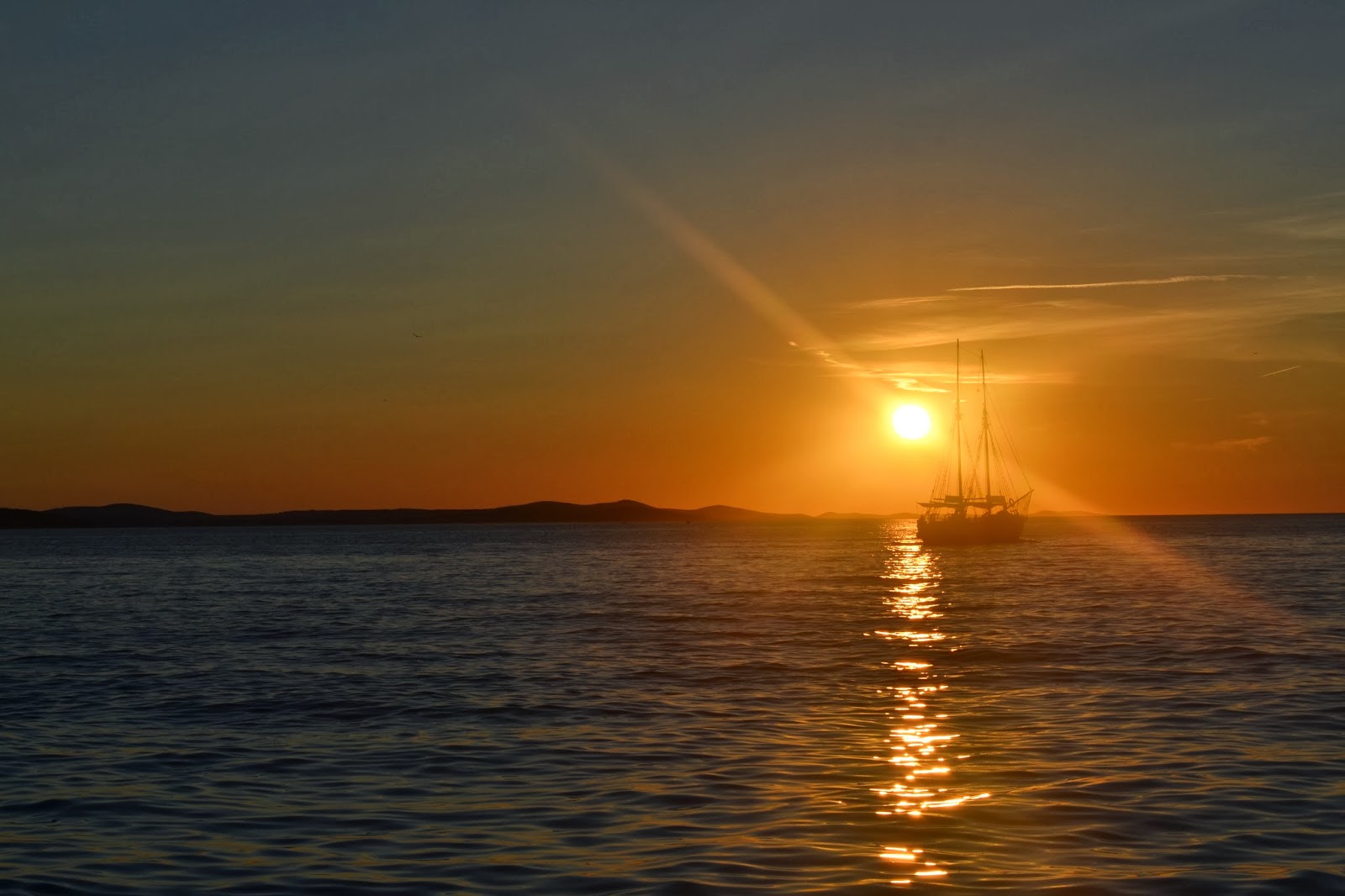
The sunsets in Zadar deserve a post of their own!  British film director, Alfred Hitchcock, once wrote, "Zadar has the most beautiful sunsets in the world".  I will let my photos do the talking...


Sunset in Zadar (source - MikeW)

Aside from the wonders that Zadar itself has to offer; outside of the city, you have easy access by boat to the Kornati Islands National Park (http://www.kornati.hr/index.php/en).  The absolutely stunning lakes and waterfalls at Plitvice (http://www.np-plitvicka-jezera.hr/) are a 2 hour car journey north from Zadar.  Even closer (about an hour's drive) is the beautiful Krka National Park (http://www.npkrka.hr/) where you will find the incredible, thundering Skradinski Buk waterfall, which you can swim in front of...along with many hundreds of other visitors!  Nevertheless, it is an amazing place to be and a great experience!  And, finally for the party animals, the island of Pag with its internationally renowned dance/house music scene at Zrce Beach, are within a short distance of Zadar.

Plitvice (source - MikeW)

The Skradinski Buk waterfall at the Krka National Park (source - MikeW)

Zrce Beach - Home to Croatia's house music scene (source - MikeW)

All in all, Zadar is one of the places you might not have heard of, or if you have, one of those cities you really do not know much about.  I say now is the time to get there and enjoy this Dalmatian jewel and all of its historical, gourmet, musical and light-fantastic pleasures.

Hvala Puna!